
Top Sports Betting Exchanges With Enough Liquidity
This article provides an overview of several well-known sports betting exchanges, focusing on how their platforms operate, their structural features, and practical considerations for users.
In highly traded markets, prices tend to converge more quickly due to greater participant activity.
Below, you’ll find factual details about several platforms, including commission structures, platform features, and general differences between exchange-based and bookmaker-based betting models.
In this peer-to-peer type betting model, users can either ‘back’ a sports outcome, betting on it to happen, or ‘lay’ it, betting on it not to happen.
One commonly cited characteristic of betting exchanges is that pricing is determined by users rather than fixed by the platform, which can result in odds that differ from traditional sportsbooks. Account limitations are generally governed by exchange-specific rules rather than betting outcomes.
1. Spreadex
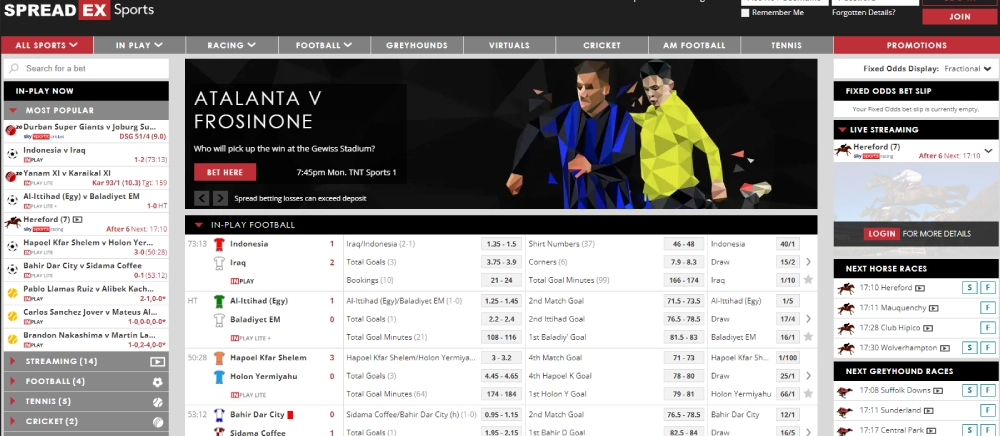
Overview: Spreadex is a UK-based platform offering both spread betting and fixed-odds betting.
Features:
- Intuitive interface with seamless navigation
- Stable, fast-loading mobile app
- Live streaming of horse and dog races for in-play betting
- Fee structures are generally lower than those applied by traditional fixed-odds sportsbooks.
- Includes financial trading options alongside sports betting
2. Matchbook
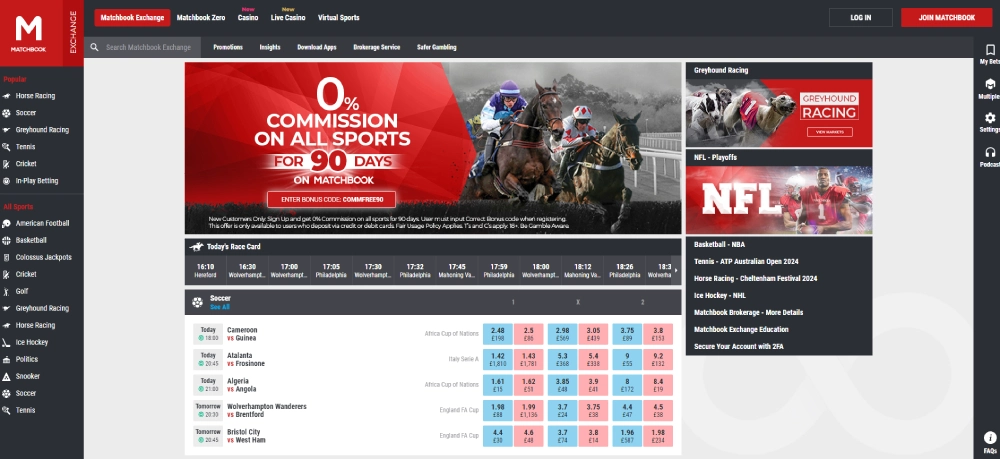
Overview: Matchbook is a globally recognized betting exchange known for its user-friendly platform.
Features:
- Secure platform with advanced encryption
- Commission policies include temporary promotional reductions for new accounts, subject to eligibility criteria.
- Well-received mobile app
- Regular promotions for existing customers
3. Smarkets
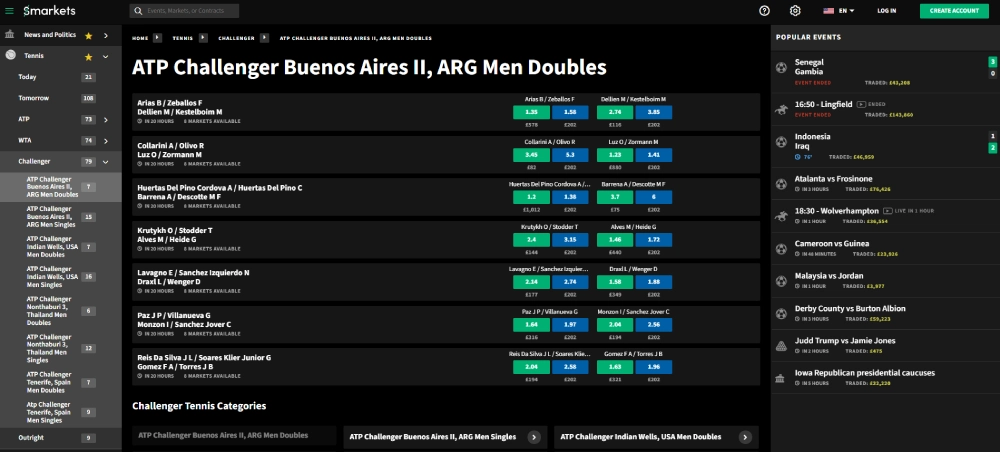
Overview: Smarkets is another top UK betting exchange with a unique offering of a 0% commission for the first 60 days.
Features:
- Detailed statistics are available for various markets, including politics
- The platform supports a range of sports and non-sports markets, including politics, with detailed market statistics.
- User-friendly site and app design
4. BETDAQ
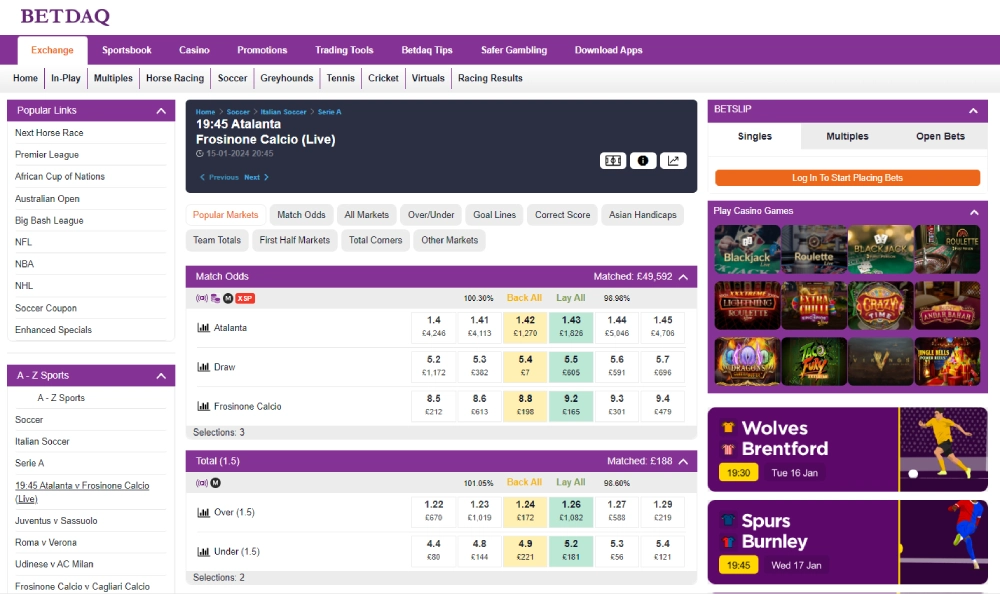
Overview: BETDAQ focuses on exchange-based wagering with lower headline commission rates on selected markets.
Features:
- Commission-free on most markets, with a competitive 2% rate on football, horse racing, greyhound racing, cricket, and virtual sports
- Cashback, free bets, and best odds guaranteed promotions enhance value
- Public API availability
- Separate website (BETDAQ Tips) with detailed trading articles and market information
- The platform provides a range of tools and market data designed to support informed betting decisions.
5. Betfair Exchange
Overview: Betfair Exchange is one of the most widely used platforms, particularly in football and horse racing markets.
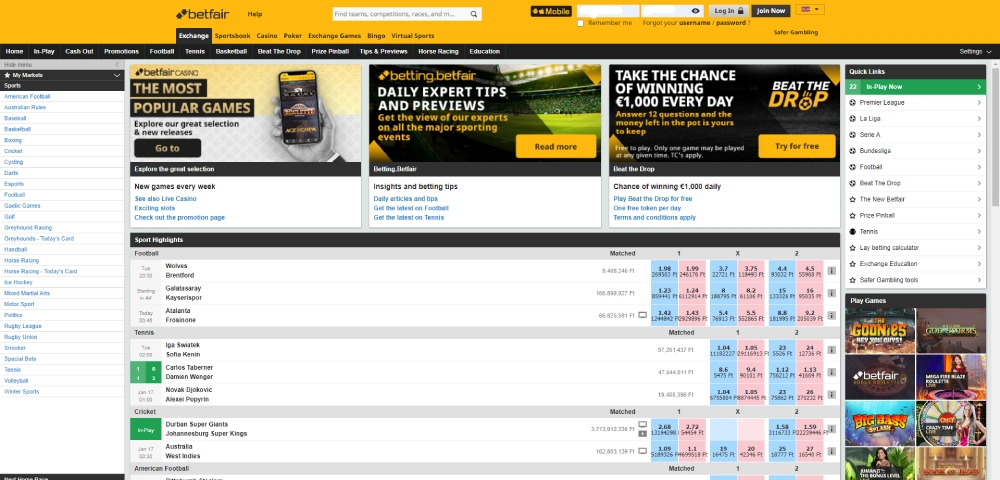
Features:
- Wide range of markets, especially popular for football and horse racing
- Betfair rewards plan allows users to reduce commission or receive other promotional benefits
- Offers carry over from the sportsbook to these platforms
- API system and integrated trading tools for in-depth data analysis
- Secondary navigation features, such as Tips & Previews and Historical Data, for an enhanced user experience
Betting exchange commission rate comparison
The following table compares the commission rates of each relevant and trustworthy betting exchange.
Commission rates and promotional terms can vary depending on the operator, user account type, and jurisdiction.
| Platform | Commission Rate |
|---|---|
| Betfair | 5%-2% |
| BETDAQ | 2% |
| Ladbrokes | 2% |
| Smarkets | 2% |
| Matchbook | 2% |
| Betconnect | 3% |
| Spreadex Sports | 2% |
Comparison of bonus offers at sports betting exchanges
| Platform | Bonus Offers |
|---|---|
| Betfair | £20 |
| BETDAQ | – |
| Ladbrokes | £20 |
| Smarkets | – |
| Matchbook | £20 |
| Betconnect | £50 |
| Spreadex Sports | £20 |
What is a sports betting exchange?
A betting exchange operates as a peer-to-peer marketplace where users can offer and accept wagers at mutually agreed odds. Unlike traditional sportsbooks, prices are determined by participant demand rather than fixed margins.
What are the components of a these platforms?
1. Many users: a betting exchange is built on the idea of peer-to-peer wagering, which requires at least two bettors for a successful and matched bet. The users are not able to play against the house.
2. Back and Lay Bets: these platforms offer two types of betting opportunities for each outcome, which are called ‘back’ and ‘lay’ bets.
The ‘back’ bet is the act of wagering on a certain outcome to happen. The ‘lay’ bet is the opposite of it, which allows wagering against an outcome to happen.
3. Odds and Liquidity: When using a betting exchange, both the odds and the maximum stake are determined by the users/bettors.
Market-driven pricing can reduce margins in high-liquidity environments.
The liquidity at a betting exchange represents the maximum stakes a user can place on a specific outcome.
4. Commission Fees: these platforms generate profits by taking a small percentage from each matched bet.
Most similar platforms take these fees from the winning side of a bet. Commission fees at betting exchanges can vary between different companies and user accounts.
Lower commission rates can reduce transaction costs over time, which may influence overall betting efficiency depending on individual usage patterns.
Commission rates vary by platform and account structure, which may affect long-term transaction costs.
5. Smart betting friendliness: Because of the different business models, betting exchanges accept and welcome smart players.
High-liquidity exchanges may support a variety of betting and trading strategies, including price comparison and market-based approaches that rely on differences between available odds.
Some users apply price-comparison or hedging approaches that rely on temporary pricing differences across markets.
Most bettors can’t see sure betting opportunities because they disappear in a matter of minutes. Scanning every bookie and sports event manually is simply impossible.
As a result, some users rely on external tools to monitor price movements across multiple markets.
Exchange users may also enter and exit positions before event completion, depending on price movements and liquidity.
What are the advantages of peer-to-peer betting markets?
Betting exchanges offer several distinct benefits over traditional sportsbooks, making them an increasingly popular choice among sharp bettors.
One of the main advantages of betting exchanges is the better odds compared to traditional bookmakers.
This odds difference comes from the way they are generated by the market/players. The market-based approach of betting exchanges often results in more competitive odds.
Another significant advantage of betting on peer-to-peer markets is the opportunity to lay bets.
This feature is not typically available with standard bookmakers. It allows users to bet against a particular outcome happening.
Commission-based pricing can reduce transaction costs compared to traditional bookmaker margins, depending on usage patterns.
These commissions are lower than the house edge at the majority of sportsbooks.
Another important advantage of betting on peer-to-peer markets is the smart bettors’ welcome policy. The exchange profit is generated based on the volume of bets placed.
No matter which outcome wins, the exchanges make a guaranteed profit.
Because exchanges operate on a peer-to-peer model, user participation is typically governed by platform rules rather than individual betting patterns, although standard compliance and risk controls still apply.
From this policy comes the winners’ welcome approach. Peer-to-peer markets platforms apply standardized rules that are less dependent on individual betting outcomes, though compliance controls still apply.
Betting exchanges generally apply consistent platform rules to all users, though availability, liquidity, and fees may vary based on market conditions and regulatory requirements.
Another advantage of an exchange is that canceled bets are very rare.
What are the downsides of betting exchanges?
While betting exchanges offer several advantages, they also come with certain downsides that are important to consider:
Firstly, betting exchanges can be more complex and intimidating for beginners compared to traditional bookmakers.
Beginner bettors may find it challenging to understand the mechanisms of placing back and lay bets, and the trading strategies involved.
This complexity requires a steeper learning curve than traditional betting methods.
Another significant downside is liquidity issues. In betting exchanges, the availability of money in the market, or liquidity, is crucial for matching bets.
For less popular events or markets, it can be challenging to find someone to match your bet, particularly for large bets.
This can limit usability for niche events or lower-liquidity markets.
Betting exchanges charge a commission on winning bets as their revenue model. In certain scenarios, exchange commissions may offset some of the pricing advantages compared to traditional bookmakers.
This is especially true for successful bettors on platforms that employ a tiered commission structure, potentially eroding the profitability of successful betting.
While popular sports and events are usually well-covered, some betting exchanges may offer a more limited range of markets compared to some traditional sportsbooks.
This limitation is particularly evident for niche sports or lower-profile events, which may not be as extensively available on exchanges.
The risk of partially matched bets is another downside. In markets with lower liquidity, there’s a possibility that only part of your bet will be matched.
This partial matching can complicate your betting strategy and make it difficult to execute your intended wagers fully.
For live betting, exchanges often introduce a delay before accepting a bet to ensure fairness.
However, this can be a disadvantage if the odds change unfavorably during the delay period, potentially impacting the bettor’s strategy and outcomes.
Betting exchanges typically offer fewer bonuses and promotions compared to traditional bookmakers.
Bookmakers often use these incentives to attract and retain customers, a strategy less prevalent in the exchange model.
In smaller markets, unusual activity can occasionally distort prices, though monitoring systems aim to mitigate this risk.
This is more likely in smaller or less regulated markets, where individuals might attempt to skew the market by placing large, misleading bets.
When you lay a bet on an exchange, you take on potentially large liabilities – the amount you could lose if your lay bet is unsuccessful.
This risk requires careful bankroll management and an understanding of the potential financial implications.
Geographical restrictions also play a role in the downsides of betting exchanges.
Their availability can be limited in certain regions due to strict gambling regulations, making them inaccessible to a segment of interested bettors.
What is lay betting at peer-to-peer markets?
Lay betting is a form of wagering where you bet against an outcome occurring. Essentially, you play the role of the bookmaker, offering odds to other bettors.
If the outcome does not happen, you win the bet; if the outcome does happen, you pay out the bet based on the odds you offered. This type of betting is typically found on betting exchanges.
How do betting exchanges make money?
Betting exchanges make money primarily by charging a commission on winning bets.
Unlike traditional bookmakers who earn from the odds margins, exchanges earn by taking a small percentage of the net winnings from users who have placed successful bets on their platform.
This commission rate varies depending on the exchange, but it typically ranges from around 2% to 5% of the winnings.
Who invented the betting the peer-to-peer betting markets?
The concept of the betting exchange was pioneered by Andrew Black and Edward Wray, who co-founded Betfair in 2000.
Betfair revolutionized the betting industry by introducing a platform that allowed users to bet against each other rather than against a traditional bookmaker.
The success of Betfair has since inspired the creation of other betting exchanges and significantly influenced the online sports betting industry.
Which platforms are commonly referenced in discussions about arbitrage strategies?
Exchange suitability depends on factors such as liquidity, commission rates, available markets, and user interface preferences.
Here are a few exchanges and bookmakers that are often considered by those interested in arbitrage betting:
1. Betfair Exchange: Known for high liquidity and a wide range of markets. Betfair is popular among arbitrage bettors despite the fairly high commission on many bets.
Some users explore alternative access methods or platforms to compare exchange pricing, though fees and access conditions vary and are subject to operator terms.
2. Smarkets: Offers a user-friendly platform with competitive commission rates. It’s a fair option for beginners and experienced bettors alike.
3. Matchbook: Known for low commission rates and a decent selection of markets, though liquidity can be an issue for less popular events.
4. BetDAQ: Similar to Betfair with slightly lower commission rates, but liquidity can be a concern, which can be time-consuming and not worth focusing on for sure bettors.
Which is the best exchange for matched betting?
When choosing the best peer-to-peer markets for matched betting, you should consider factors such as the range of markets, liquidity, commission rates, and user-friendliness of the platform. Here are some popular options:
1. Betfair Exchange: Often the first choice for many matched bettors due to its high liquidity, which is crucial for placing larger bets. Betfair offers a wide range of markets, but keep in mind their commission fees.
2. Smarkets: Known for its user-friendly interface and lower commission rates compared to Betfair, Smarkets is popular among matched bettors, especially for smaller or more regular bets.
3. Matchbook: Offers competitive commission rates and a decent range of markets. However, liquidity can sometimes be an issue for less popular events.
4. BetDAQ: Similar to Betfair with a wide range of markets, but typically has lower commission rates and lower liquidity. Many times, it can be time-consuming to find a betting opportunity that can be matched with the right-sized stakes.
Is there a betting peer-to-peer market for American bettors?
Availability depends on regional regulation, which varies by jurisdiction and may change over time.
Most US states that have legalized online sports betting have only authorized traditional sportsbooks.
Our relevant guide: Sports arbitrage finding in Australia.
Why do betting exchanges delay live bets?
Live betting delays are primarily implemented to maintain market fairness and account for broadcast and data transmission delays across different users.
These users want to take advantage of knowing the outcome of a market and betting before the bookies/exchange users could change the odds.
This type of betting would hurt the reputation and user experience at these platforms. So, these platforms chose to apply a delay to each in-play bet.
How long is the delay at peer-to-peer betting markets?
The delay applied to in-play bets depends on the sport you want to wager on. For example, Betfair applies a delay of 2 seconds on horse racing bets, 5-8 seconds on football bets, and 5 seconds on the majority of other sports.
How are the odds so accurate at these platforms?
Betting exchanges are based on a peer-to-peer wagering business model, which allows users to bet against each other. Users try to offer the most accurate and highest odds to get their bets matched (accepted by other users).
This approach results in high but also accurate odds because, after a certain level, users get to a point where both the back and lay odds are close to the real probability of the outcome.
Alternatives to traditional betting exchanges include brokerage platforms, sportsbooks, and other market-based services, each with different structures, fees, and regulatory considerations.
