
Matched Betting in the USA: How It Works, Upsides & Risks
Important disclaimer (read first):
Matched betting does not eliminate risk, does not guarantee profits, and does not provide a stable or permanent income source.
Results depend on execution accuracy, bookmaker rules, account limits, state regulations, and timing.
Figures mentioned below are illustrative, not promises or financial advice.
I have tested and practiced several betting strategies over multiple years.
Matched betting, sometimes referred to as bonus utilization, was one of the first structured approaches I explored to reduce exposure when using bookmaker promotions, although it still involved operational and execution risk.
Matched betting in the United States has gained increased attention as more states have legalized online sports betting and the number of licensed sportsbooks has expanded.
However, describing matched betting as “no-risk” or “guaranteed” is misleading, especially in regulated Tier-A markets where bookmakers actively monitor betting behavior.
Matched betting software in the USA: why tools are commonly used
Many bettors are unsure whether subscribing to matched betting software provides enough value to justify the cost.
Based on my experience, attempting matched betting in the USA without software significantly increases the likelihood of losses, missed opportunities, or inefficient execution.
Without matched betting software, many potential bonus conversions result in negative expected outcomes.
For example, wagering at -200 on one sportsbook and +180 on another means that each $100 wagered loses approximately 2.32% of the total stake.
After wagering $700 under similar conditions, the accumulated loss can exceed the monthly subscription cost of many software tools.
Odds change quickly, even for pre-match events.
If execution is slow or manual, many opportunities disappear before bets can be placed, leading to missed conversions or unbalanced exposure.
Finding suitable matched betting opportunities manually is also time-intensive.
In some cases, the effective hourly return may be lower than a standard full-time job, particularly once mistakes and delays are accounted for.
OddsJam for US bonus utilization
OddsJam began offering services in 2021 and has grown rapidly by focusing on US-regulated sportsbooks.
At the time of writing, the platform is followed by tens of thousands of users, although popularity does not equate to guaranteed results.
OddsJam’s Low-Hold tool is designed to help identify betting pairs with minimal expected loss, not zero loss.
By aggregating odds from 36+ US sportsbooks, it aims to display pricing discrepancies faster than manual comparison.
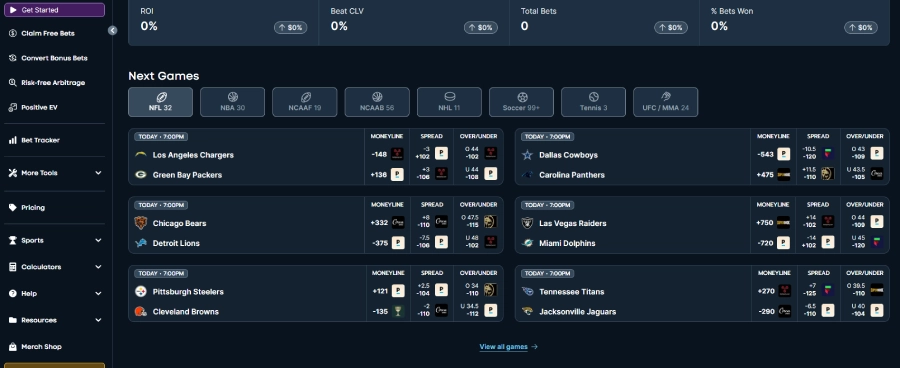
Advantages of OddsJam for matched betting (with limitations)
- Real-time odds comparison across US sportsbooks, though delays can still occur
- 7-day free trial, allowing users to test functionality before committing
- Clean interface and responsive customer support, though user error remains possible
- Educational content covering arbitrage betting, value betting, and bankroll management
Important limitation:
Software does not prevent execution errors, voided bets, rule violations, or account limitations.
Some bettors also use external tools to track wagers and analyze outcomes.
Using analytics tools can help identify mistakes, inefficiencies, and declining returns, but they do not improve odds or override bookmaker rules.
What does “no-risk” matched betting actually mean?
Claims of “guaranteed” or “risk-free” profits should be treated with skepticism, especially in regulated markets.
Bookmakers typically operate with a 3%–9% margin, which ensures profitability against unstructured betting behavior.
This dynamic changes only when bonuses are involved, as promotional offers temporarily alter expected value.
Matched betting relies on using bonuses, not on beating sportsbook pricing models.
It works only while promotions exist and while accounts remain unrestricted.
Is matched betting in the USA legal?
Matched betting is legal only in US states where online sports betting is legal and sportsbooks are properly licensed.
It does not involve illegal activity when wagers are placed at licensed operators under their stated terms.
However, matched betting is best described as using promotional structures, not exploiting a loophole.
Bookmakers allow bonuses but reserve the right to limit, restrict, or remove offers at any time.
All funds are deposited with licensed sportsbooks, meaning wagers themselves are legal.
That said, legality does not imply long-term viability or account stability.
How matched betting works in the USA (step by step)
1. Confirm betting legality in your state
This is critical.
Using sportsbooks without a valid state license introduces legal, financial, and withdrawal risks that outweigh potential benefits.
2. Have sufficient starting capital
In many countries, welcome bonuses are €20–€30.
In the US, sportsbooks often offer $2,000–$3,000 in promotional value.
Even when targeting smaller bonuses such as $500, a bettor may need $1,500–$2,000 in available capital to complete wagering requirements safely.
Negative scenario:
Insufficient capital can force bettors to place unbalanced wagers, increasing loss risk.
3. Use a matched betting software
Manual matched betting is possible but slow, error-prone, and inefficient.
Matched betting typically involves identifying overpriced odds, such as +200 instead of +160, and covering the opposite outcome at -200.
When executed correctly, both outcomes may return similar results, allowing the bonus wagering requirement to be completed.
However, execution mistakes, odds movement, or stake miscalculations can result in losses.
These pricing discrepancies can appear and disappear within minutes.
Given the volume of daily sports markets, identifying them consistently without software is difficult.
Matched betting tools scan multiple markets continuously, but they do not guarantee availability or accuracy.
Some tools offer free trials or low monthly fees.
A subscription cost of $15–$20 per month can be reasonable when working through $5,000 in bonuses, but only if execution is correct.
Is matched betting in the USA profitable?
Matched betting can be profitable only while bonuses are available and accounts remain unrestricted.
Profitability varies by state, sportsbook availability, and promotional structure.
Some US sportsbooks offer $500–$1,000 bonuses, compared to €100 in parts of Europe.
This difference increases short-term potential but also increases scrutiny and account monitoring.
In some states such as New York or New Jersey, total bonus value may exceed $10,000.
Under optimal conditions, some bettors report withdrawing approximately 85%–90% of bonus value.
Negative scenario:
This assumes no stake limits, no errors, no voided bets, and continued eligibility — conditions that rarely persist long-term.
Downsides of matched betting in the USA
If bettors focus on obscure or low-liquidity leagues, sportsbooks may flag accounts more quickly.
Once an account is limited, matched betting becomes extremely difficult, especially when large wagering requirements remain.
Matched betting requires significant starting capital, particularly in the US market.
Capital tied up in wagering cannot be used elsewhere and may be inaccessible during reviews or withdrawal delays.
Conclusion
Matched betting in the USA is a structured way to use sportsbook bonuses, not a risk-free strategy and not a permanent income solution.
It can help reduce variance when used carefully, but account limits, execution errors, and changing promotions limit sustainability.
Among available tools, OddsJam offers broad US sportsbook coverage, but software does not remove risk or guarantee outcomes.
